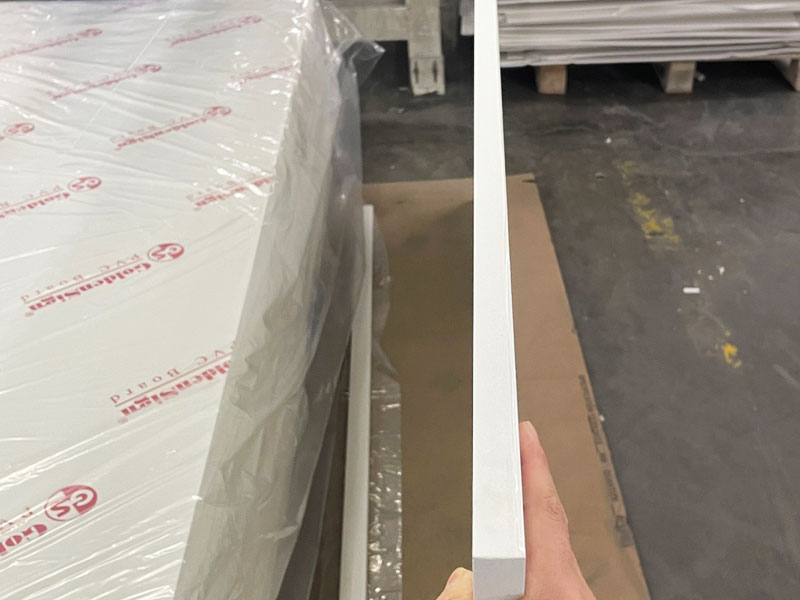
Most buyers know how PVC foam board looks. Smooth surface. Light weight. Easy to cut, print, route.
But once sourcing moves from trading to long-term supply, the real question changes to something deeper: What is PVC foam board actually made of — and why does the formulation matter so much?
Because in a real PVC foam board factory, the difference between a stable sheet and a problematic one is not visible on day one. It comes from raw materials, temperature control, foaming balance… small details that decide everything later.
The Core Raw Material: PVC Resin
At the center of every PVC foam board is suspension-grade PVC resin.
This resin provides:
Basic rigidity
Chemical resistance
Process stability
But resin alone cannot foam. It needs a full formulation system.
A typical expanded PVC foam sheet from a professional PVC foam board manufacturer includes:
Calcium carbonate (for density control and cost balance)
Foaming agents (to create the internal cell structure)
Stabilizers (heat resistance during extrusion)
Lubricants (to control melt flow)
Impact modifiers (to improve toughness)
Processing aids (for surface quality)
The ratio between these materials is where factory experience shows. Same ingredients — completely different board performance if the formulation is not precise.
That’s why large-scale projects usually stay with one reliable supplier like Goldensign. Changing factory often means re-testing everything.
The Real Production Process — More Than Just Extrusion
In a modern PVC foam board factory, the production line looks continuous, but each section has its own critical control point.
1. High-Speed Mixing
All raw materials are heated and mixed to a uniform dry blend. Temperature here is sensitive. Too high — foaming agent starts reacting early. Too low — poor plasticization later.
2. Conical Twin-Screw Extrusion
This is the heart of the process.
The melt temperature, screw speed, and pressure must stay in balance. Foaming happens inside the barrel. If the pressure is unstable → uneven cell structure → weak board core.
3. Calibration and Cooling
The hot sheet enters a calibration platform where thickness and surface flatness are fixed.
This step decides:
Thickness tolerance
Surface hardness
Internal density distribution
A skilled PVC foam board manufacturer keeps long calibration tables running at stable vacuum and cooling speed. That’s how you get sheets that stay flat after CNC cutting.
4. Cutting and Stacking
Even this final step affects board performance. Improper cooling time can cause internal stress, which shows later as warping.
The Most Difficult Part: Foaming Balance
Foaming is not about making the board lighter. It’s about making the cell structure uniform.
Common problems from inexperienced factories:
Large cells → brittle board
Uneven density → surface sinks during printing
Over-foaming → low screw holding strength
Good PVC foam board has fine, closed, even cells. You see it immediately when cutting the sheet.
This is where Goldensign’s production control makes a difference — stable density from edge to center, which matters a lot for routing and engraving users.
How a Factory Judges PVC Foam Board Quality
Inside a professional PVC foam board factory, quality is not judged by appearance alone.
Key checks include:
Surface Performance
No flow marks No bubbles Consistent color
Thickness Tolerance
For CNC users, even 0.1 mm variation affects processing depth.
Density Consistency
Same density across the whole sheet — and across different batches.
Screw Holding Strength
Directly related to furniture and cabinet applications.
Bending Strength
Too brittle means formulation imbalance.
Goldensign runs these tests batch by batch, which is why their boards behave the same in printing workshops in Europe, the Middle East, or South America.
Why Buyers Should Care About the Manufacturing Process
Because PVC foam board is not a commodity in real use.
For distributors searching PVC foam board manufacturer for long-term cooperation, production control means:
Fewer customer complaints
Stable machining performance
Predictable delivery quality
And that reduces hidden cost more than any small price advantage.
Final Thought
So, what is PVC foam board made of?
PVC resin, yes. But more importantly — a controlled formulation, a stable extrusion system, and a factory that understands foaming, not just board thickness.
That’s the difference between a sheet that only looks good on delivery day and a sheet that performs for years.
And that’s exactly where a mature manufacturer like Goldensign shows its real value — not only producing PVC foam board, but producing consistency for global projects.
ABOUR GOLDENSIGN
Goldensign Industry is a professional PVC foam board manufacturer with over 20 years of experience in plastic sheet production.
If you are interested in PVC foam board, please feel free to contact Goldensign.
We value your privacy, and your information will not be disclosed. Goldensign is a professional manufacturer of PVC foam boards, acrylic sheets, and other plastic sheet materials. Feel free to leave us a message.